Looking beyond life as a bioscience university professor

Photo by Vic
Photo by Vic

Life as a tenured university professor seems idyllic with its job security, intellectual freedom, prestige, livable wage and flexible schedule. No wonder so many bioscience students aim to become professors.

But numerous factors, including a lack of available faculty positions, are making bioscience trainees consider other careers. That’s been the experience for Scott Carlson, PhD, a Stanford postdoctoral research fellow in biology, who recently told me:

“My dream job is a baffling question right now. When I started as a postdoc, I would have said my dream job was to be a professor at a program in interdisciplinary biology or bioengineering. After five years as a postdoc, I’m not sure anymore but I don’t know what to replace it with. Academia makes it impossible to explore other options. If I leave, my grants would disappear and it would be hard to get back in without recent publications.”

Carlson isn’t alone. It’s increasingly difficult to secure a spot as a tenure-track faculty member, even for those who spend years conducting research first as a student and then as a postdoc. According to the National Institutes of Health’s 2012 Biomedical Workforce Working Group Report, “Although the vast majority of people holding biomedical PhDs are employed (i.e., unemployment is very low), the proportion of PhDs that move into tenured or tenure-track faculty positions has declined from ~34 percent in 1993 to ~26 percent today.”

This decline in bioscience faculty positions is correlated with funding difficulties. For example, the success rate of researchers applying for new NIH grants dropped from 28.2 percent in 2000 to 16.3 percent in 2015, and the success rate for grant renewals dropped from 52.7 percent to 28.6 percent for the same years. In addition, grants tend to go to established investigators, making it even more difficult for postdocs or new professors to secure funding.

One solution proposed by the NIH working group is to change graduate training so it is no longer “aimed almost exclusively at preparing people for academic research positions.”

Stephanie Eberle, director of the Stanford School of Medicine Career Center, works with students, MDs, PhDs and postdocs from all the biosciences. She agreed that it’s time to “revisit the value of graduate education” and added:

“It isn’t just for an academic job, and it hasn’t been for a long time. We need to allow our trainees to explore other options while they’re here. For instance, we offer some biotechnology business and finance classes at Stanford. Improving our trainees’ business skills improves their chances in any career, academia included, by helping them stand out in a competitive market.”

However, Eberle and Carlson both acknowledged that this requires a change in culture. “There’s little direct pressure from colleagues, but there’s a strong implicit feeling that an academic career is somehow the most successful or prestigious career path,” said Carlson. “I didn’t get this sense as much when I was doing my PhD in bioengineering, but it’s pervasive in biology. I think it’s a big problem in academic culture and a huge disservice to the trainees.”

Eberle concluded:

“Most faculty assume all the students intend to go into academia, but some of our students don’t even want to go into academia in the first place. People aren’t talking and they’re making assumptions — that’s a problem. My charge is to help support our trainees’ combined academic, professional and career development. We need to help them find the career that fits them best.”

This is a reposting of my Scope blog story, courtesy of Stanford School of Medicine.

“Ultimately about discovery”: High school students experience hands-on biology research

Photo of Seung Kim and former student Emma Herold (Steve Fisch)

In high school, most science classes involve students reading a textbook and doing experiments with known answers. Not Bio 470: Biology Research — an experimental molecular genetics biology course developed in partnership with Phillips Exeter Academy in New Hampshire and Seung Kim, MD, PhD, a professor of developmental biology at Stanford.

Kim was inspired to develop this unique high school biology class several years ago after visiting Exeter, his alma mater. He explained in an interview:

“I became aware that they were teaching science in a way very similar to how I’d learned it, which gave me pause as a practicing scientist because it didn’t reflect how science is really done. When we learn things in school, there should be no distance between us and the primary material. When you learn to play baseball or music, you don’t just read about it in textbooks. Instead, you play and try to mimic what professionals do.”

As a result, two Exeter instructors, Anne Rankin and Townley Chisholm, and a few of their students came to Kim’s research laboratory at Stanford the following summer to learn basic techniques for breeding and genetically manipulating fruit flies. Based on this training, the team launched an 11-week biology research course with 12 upper level students per year. The instructors teach the course at Exeter each spring, but both the teachers and students are in regular contact with Kim and his colleague, Lutz Kockel, PhD.

Drosophila, or common fruit flies, are an important model organism widely used in thousands of bioscience laboratories around the world, because these fast-breeding insects share much of our genetic heritage – fruit flies have 75 percent of genes that cause diseases in humans.

In class, students delve into fly genetics, molecular biology and embryology to generate and characterize new fruit fly strains. Kim explained their research:

“People have developed ways to turn genes on or off in fruit flies, using genetic tools that exploit elements from yeast gene control factors; there are whole libraries of these yeast-based genetically-modified fruit flies stocked around the world. But you need more than one independent system, so you can study complicated things like how cells talk to each other or how they interact in time during development. The research goal of our class was to generate a whole new set of genetically-modified fruit fly stock that used bacteria instead of yeast — creating a resource for the scientific community to perform their own research.”

If they succeed, great. But success isn’t guaranteed.

“The students, instructors and researchers don’t know what the outcome will be of their work, so it creates the actual emotions, effort and experience of being a scientist. The goal is to give young people a deeper understanding of what science is, which is ultimately about discovery,” Kim said.

The model worked well for Maddie Logan, an Exeter alumnus who is now a premed undergraduate at Yale University. She called it an incredible experience: “Biology 470 was very different from other classes in that it was 90 percent lab work. Every day we’d come into class, check in with the theory behind what we were doing that day, and then go to the lab benches to do our research. I learned that things in the lab only occasionally go as planned, and a real scientist has to be able to figure out what went wrong and how to correct it for next time.”

After taking Bio 470, a few students like Logan come to Stanford each summer to continue the research in Kim’s lab. “The whole strategy was to not worry about finishing anything in 11 weeks,” said Kim. “Over the last four years, students have accrued reliable data that we’ve now put together into a unique paper.”

Their paper has just been published in the journal G3: Genes, Genomes, Genetics— a major milestone for the project. According to the manuscript’s peer reviews, the students have produced a novel collection of fruit fly lines that will be “very useful to the scientific community to study diverse biological questions.”

Starting this fall, Kim and Lutz are expanding their genetics educational program to include Commack High School, a public school in Long Island, New York. They are also hoping to create a similar biology research course in a “high-needs” high school in the future.

For Kim, the project is a personal passion. “The thing that gives me the most joy is to see students’ faces light up when they really understand and really engage in the scientific process,” Kim said. “I’m trying to get people to see the beauty in science.”

This is a reposting of my Scope blog story, courtesy of Stanford School of Medicine.

Neuroscience camp: Teens learn about mental health

image.img.620.high
Photo by Norbert von der Groeben

As a teenager, I spent summers swimming and sunbathing at the community pool. However, many teens from around the country found something more interesting to do this summer: neuroscience summer camp at Stanford.

Over 100 high school students attended Clinical Neuroscience Internship Experience (CNI-X) 2016 — an intensive, weeklong summer program that introduced them to the breadth of work underway by researchers from the Department of Psychiatry and Behavioral Sciences. Students came from throughout the Bay Area and as far away as Georgia and New York.

Several dozen department faculty members taught 90-minute classes, ranging from introductory seminars to hands-on workshops and laboratory tours.

For example, in one session, the teens constructed brains out of Play-Doh, shown above. In another, Kate Hardy, DClinPsy, clinical assistant professor of psychiatry and behavioral sciences, taught a group exercise designed to build empathy for people that hear voices, such as schizophrenics. During the exercise, two students conversed while a third whispered in one’s ear. Hardy described the results in a recent news story:

“Some students said they found it hard to concentrate; others said the experience was scary or threatening. When I do this exercise with adults, it’s difficult to get them to respond. The teens got right into it. There’s a great benefit to exposing people at that age to the prevailing preconceptions of psychosis and reduce the stigma, even at a small scale.”

The goals of the CNI-X program are to identify promising students interested in mental health and to destigmatize mental illness through education.

“With CNI-X, our faculty are taking the most direct route to the future — by introducing incredibly bright, motivated young people to the excitement and diversity of clinical neuroscience,” said CNI-X program co-director Laura Roberts, MD, MA, professor and chair of psychiatry and behavioral sciences, and chief of the psychiatry service at Stanford Health Care. “We introduce novel science to the interns…. My guess is that in several years we will see some of these students in our medical school classrooms.”

This is a reposting of my Scope blog story, courtesy of Stanford School of Medicine.

What color is your cloud? Study finds large variability in resident workloads

Photo by Scott Schiller

For decades medical residents have put themselves into two camps: “black clouds” and “white clouds.” Black-cloud residents carry with them the bad luck of consistently getting a patient load that requires more work; the perceived workload intensity and stress may keep them pacing the halls at night, while their white-cloud counterparts are likely to sleep peacefully while on call.

Does this cloud status actually exist, though? Adam Was, MD, fourth year Stanford resident of pediatrics and anesthesia, decided to find out. The results of his study were just published in Pediatrics.

“The study was inspired by my late-night argument with other interns about our workloads,” said Was. “We commonly discuss what type of cloud we have, meaning what kind of workload. So one of the interns said his workload was really high, but someone else argued that we all have the same workload and he was just complaining about it more. I realized that we could do an objective, rigorous study of actual workloads to get a real answer.”

With the help of KT Park, MD, assistant professor of pediatric gastroenterology and senior author of the study, Was measured the workload of twenty-six pediatric residents during the six core inpatient rotations of their intern year — to make sure they were comparing “like to like.” Using the Stanford Children’s Health research database, they quantified the workload intensity of each of the residents based on the number of electronic notes and orders that they wrote while in the hospital. Was explained:

“ We wanted to focus on objective data that described the work done at the hospital, as opposed to just the number of hours spent there. Residents do a lot of things that aren’t captured in electronic notes and orders, but we found this data to be the most robust and representative.”

And the outcome? The differences are real. The researchers found a very significant variability of workload intensity between the residents. High-workload residents wrote 91 percent more orders and 19 percent more notes than low-workload residents. Here’s Park:

“I really thought that we were going to conclusively lay to rest this idea that there is statistically significant workload variability between residents. I was very surprised. We did sophisticated mathematical models and there is no way around it — there are high-workload and low-workload residents. There is no ethological explanation right now, and it remains a big question mark especially for program directors.”

Thinking through the study’s implications from a program director’s point of view was the main role of the third author, Becky Blankenburg, MD, clinical associate professor of pediatrics and pediatric residency program director, who thinks the results can guide residency directors. “This data provides more information for resident assessments and will allow us to better individualize the residents’ curriculum based on what they’ve really been exposed to,” she said.

Determining the root causes behind this workload variability is beyond the scope of their study. However, the authors have a few of their own theories.

One belief: high-workload or black cloud residents behave differently than their white cloud colleagues. For example, some black cloud residents may be inefficient, while others may create extra work for themselves. And some white cloud residents may need to be more vigilant.

“I would like to get into the heads of the residents in real time,” Park said. “As they put in that note or order or take that phone call, what is the impetus? From my observation, anxiety and perfectionistic tendencies drive them to do more than what’s necessary for effective patient care.”

Blankenburg agreed, “Some residents early on learn to look at the big picture and some see only the trees without seeing the forest. Another important factor is how comfortable people are with ambiguity. If you’re able to deal with ambiguity better, you might not order as many tests.”

The researchers are contemplating how best to use this information and how to design a follow-up study to understand the root causes of resident workload variability. One idea is to somehow incorporate peer evaluations, since their study found self-assessments to be inaccurate. “I think peers would do the best job of picking up on cloud status or workload intensity,” Blankenburg said.

Although successful, did the study settle the late night argument that inspired it?

“The study data was annonymized, so we don’t know who was who,” said Was. “So I never got to settle my original argument of whether I was doing more or less work. Before the study, I thought I was a black cloud. Afterwards, I feel like I’m a confused and possibly grey cloud.”

This is a reposting of my Scope blog story, courtesy of Stanford School of Medicine.

Becoming Doctors: a podcast featuring Stanford medical students is revived

2743534799_e1c988d6be_z
Photo by Patrick Breitenbach

I admit it: I’m an NPR and podcast junky. I tune in every Saturday to NPR’s Wait Wait… Don’t Tell Me and This American Life, and I can’t wait for the third season of Serial. So I was extremely excited to hear that Stanford Medicine’s podcast, Becoming Doctors, was being relaunched.

A School of Medicine graduate, Danica Lomeli, MD, originally started the podcast series to document and share the intense clinical experiences of her classmates as they trained to become physicians. After making several episodes, Lomeli passed the project on to Stanford medical student Emily Lines — a perfect fit, since Lines was a DJ at college radio stations throughout undergraduate and graduate school.

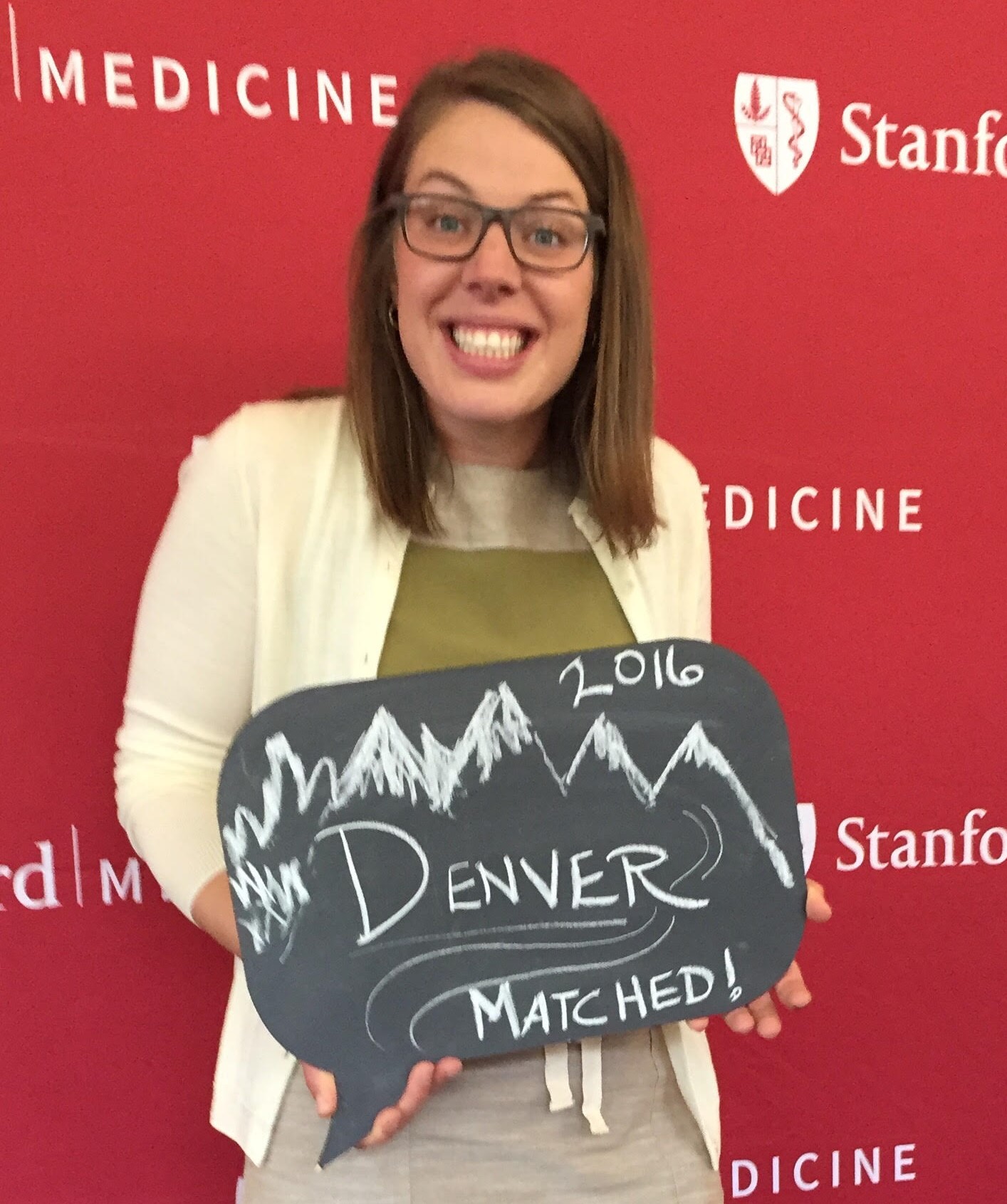
Initially Lines, shown here, used Becoming Doctors to share the stories of pre-clerkship students in their first two years of medical school, as described previously in Scope. Lines is now graduating and moving on to a residency in family medicine at the University of Colorado, Denver. Before she leaves, she relaunched her podcast to document the stories of a few of her fellow medical students who are interested in primary care and community medicine.

Emily Lines on match day (courtesy of Emily Lines)

There are three new episodes available and a few more are on their way. Each episode is between 10 to 20 minutes long.

For instance, in the new “Adding Layers” podcast, Paula Trepman shares why she is interested in family medicine — based on her experiences as an undergraduate working abroad at rural primary care centers and her clinical experiences through Stanford at the Pacific Free Clinic and Mayview Community Health Center.

Lines told me about her new podcasts in recent emails:

What inspired you to relaunch Becoming Doctors with a new focus on primary care?

As I was interviewing for residency positions in family medicine, I met so many extraordinary people from other medical schools. I was really inspired by the types of things they were doing to promote primary care and family medicine in their programs. In turn, I was also eager to share with them what was happening at Stanford — many people were surprised to learn about the growing presence of the field at a research university. It seemed like a natural transition to use my podcast to seek out the stories of those who are championing primary care at Stanford, and to share them.

There’s a really incredible group of people at Stanford who are doing academic research in primary care, advocating for primary care in medical education, and starting grassroots organizations in local communities. Others are just delighting in taking advantage of the clinical educational opportunities in primary care here at Stanford. I wanted to give voice to our inspiring community!

My first portion of the podcast series focused on pre-clerkship students. This relaunch addresses students from all stages who are interested in primary care and community medicine. There’s value to looking at why students are drawn to primary care at the start of medical school, as well as how their clinical experiences shape this interest.

Why do you want to document the stories of medical students?

My podcast has always been centered on the idea that storytelling is an incredible tool for medical students. By telling our stories, we can develop a practice of introspection and mindfulness about our challenging career. It allows us to stop and think about what we are seeing and experiencing and to decide how we want to assign meaning to these experiences. By listening to these stories, we also learn to see the world from another perspective, which is ever valuable as a clinician.

In the era of the Affordable Care Act and healthcare reform, our eyes are on primary care as one of the main channels to improve the health of our country. I’m eager to see the role Stanford will play in this process, both from a research and clinical perspective. I thought it would be timely to document some student experiences in this changing era.

What is your favorite podcast (besides Becoming Doctors)?

NPR’s This American Life inspired this podcast — it used to be called This Medical Student Life! However, my personal favorite is a podcast called the Dirtbag Diaries. I’m a rock climber and general lover of the outdoors and it’s a podcast about great people who do great things outside!

This is a reposting of my Scope blog post, courtesy of Stanford School of Medicine.
Stanford medical student co-authors guidebook for aspiring science students

Photograph courtesy of James Pan

Academic hurdles in college stymie many budding doctors, engineers and researchers: More than half of all college students who enter science, technology, engineering and mathematics (STEM) fields change their majors or drop out.

As an undergraduate, Yoo Jung Kim — now a first-year Stanford medical student — and three colleagues at the Dartmouth Undergraduate Journal of Science observed this attrition first hand and decided to do something about it. Together, they wrote a practical guide for aspiring science students, providing insider advice on topics ranging from how to pick a major to how to start a research project. Kim told me about her new book, What Every Science Student Should Know, in recent emails:

What inspired you to write this guide for science students?

“In November 2011, the New York Times published an article titled, Why Science Majors Change Their Minds (It’s Just So Darn Hard). At that time, all of us had seen friends struggle with their science classes; some of our peers had even been discouraged enough to change their majors. This article confirmed to us that the problems with STEM education were a nationwide phenomenon and we felt like we already had some of the solutions.

We started interviewing highly successful science students at Dartmouth and other colleges throughout the country to see what they were doing differently. From there we distilled those observations into sample chapters that we pitched to literary agencies and publishers. Too many college students planning to study science and medicine change their minds later in their academic careers. Many of these students slip through the cracks in massive lecture‐based classes where they don’t necessarily get much advice or attention. We feel that our book could provide the guidance that most students need.”

Who is your target audience?

“We wrote this book primarily as a resource for early college students and ambitious junior and senior high school students interested in the sciences. However, its content can benefit anyone from a high school freshman to a recent college graduate. Our book covers ways in which students can improve their study skills, master their courses, find mentors who can guide them, conduct scientific research and prepare for their future careers.

Our hope is that readers will find the book to be a pretty comprehensive guide to their life as a science student, as well as their transition from college to the outside world. The book draws on interviews with a full spectrum of different science majors, winners of national scholarships like the Rhodes, founders of startups, researchers, and more — to give a broad overview of where science can take you.”

How did you find time to write a book during college?

“By the time we had secured a publishing contract, most of us had graduated from college already. We were literally dispersed throughout the world — Beijing, Michigan, and New Hampshire — so we held Skype meetings every two weeks. We kept to a tight schedule based on an outline we had come up with early on in development. As for myself, Dartmouth College let me work on the book for academic credit as part of an independent writing project during my senior year. We all spent many nights and weekends writing the manuscript over the course of a few years time.”

Are you planning to write any more books?

“Yes! There are a couple of subjects that I’ve been wanting to pursue, but the biggest problem is finding the time, especially since medical school is already a full‐time endeavor. In the future, I want to write a book that showcases scientific research as a human endeavor filled with setbacks and triumphs.”

What advice do you want to pass on to new college students?

“Don’t get overly discouraged by a bad grade in a science class. Throughout the country, science classes tend to give students lower grades than classes in other subjects. A bad grade is not necessarily a reflection of your work ethic or aptitude for science.

By the end of my sophomore year, I had racked up several Bs and B minuses in college science courses. I wondered whether I’d be able to get into any medical school, let alone Stanford. Fortunately, I found mentors at Dartmouth who helped me regain my confidence: physician mentors who helped me prioritize my time and upperclassman who shared their study tips and cheered me on. Starting in junior year, I aced all of my courses. I asked the upperclassmen that helped me to succeed — Justin Bauer, Andrew Zureick and Daniel Lee — to join me in writing our book, so that everyone could have the mentorship experience that I had been lucky enough to receive.”

This is a reposting of my Scope blog story, courtesy of Stanford School of Medicine.

Video series focuses on bridging cultural gaps in the clinic

Imagine you visit a doctor in a far-off land with a different language. Although you have an interpreter, the doctor barely looks at you — instead relaying all information through the interpreter. You feel extra, ignored. If anything, you are building a relationship with the interpreter, not the doctor.

And that’s not good, VJ Periyakoil, MD, clinical associate professor of medicine, points out in the video above.

Our goal is to talk with the patient, through the interpreter, not talk about the patient, to the interpreter.

The video is part of the Stanford Cross Cultural Medicine Microlecture Series, a series of very short talks (about one to five minutes) that aims to bridge the growing communication gap between doctors and their patients as the U.S. population becomes older and more diverse. There are already 11 million Americans that are nonliterate in English and 25 million with only limited English proficiency.

Are doctors prepared?

These talks highlight key issues in cross-cultural encounters, including a range of practice tips for health professionals provided by experienced medical interpreters and from Periyakoil. The videos typically end with a take-home message listing the problem and solution — making it easy to quickly learn the concept. Periyakoil and her colleagues hope that health professionals will use the series as a tool to reflect on their own practice.

Microlecture 4 emphasizes the importance of talking directly to the patient even when working with a medical interpreter. Patients with limited English proficiency have the right to complete healthcare information, as well as the right to the therapeutic bond between every doctor and patient.

There are currently 16 microlectures posted on the website, but many more are on their way. A total of 44 microlectures have been made and two new ones are being released each week. The lectures also build off recommendations developed in a paper on ethnogeriatrics by the American Geriatrics Society. 

This is a reposting of my Scope blog story, courtesy of Stanford School of Medicine.

Fertility quiz: How well do you know your body?

2364734203_937bfdfe48_z_Flickr_ScottMaxwell
Photo by Scott Maxwell

Remember all the rumors that you heard about sexuality and fertility as a teen (or even a 20-something or a 30-something)? It’s hard to sort out fact from fiction.

According to the Institute for Reproductive Health (IRH) at the Georgetown University Medical Center, an accurate understanding of sexuality and fertility is surprisingly low around the world. That’s why IRH has created an online quiz to probe fertility awareness, called “Know Your Bod,” which poses the challenge: “You live with your body everyday. Do you really know it? Find out.”

The online quiz asks ten questions including the true-or-false query, “A woman will get pregnant only if she has sex on the same day she ovulates?” After you select an answer, the quiz provides a simple educational summary that explains the correct answer. At the end, it shows your score and how you compare to the general population.

The quiz was officially introduced this week at the International Conference on Family Planning in Indonesia. It was developed as part of IRH’s Fertility Awareness for Community Transformation Project, which strives to increase fertility awareness and the use of family planning.

Victoria Jennings, PhD, director of IRH, explained in a recent Georgetown press release:

Accurate understanding and awareness about human fertility is surprisingly low around the world, regardless of age, sex or education level. If we could lift the taboos and improve fertility awareness, would people be informed and empowered to make better sexual and reproductive health decisions? At IRH, we believe the answer to this question is ‘yes.’

So why not take the challenge? How well do you know your bod?

This is a reposting of my Scope blog story, courtesy of Stanford School of Medicine.

Superheroes to the rescue: a creative approach to educating patients about asthma

Video by © 2015 Booster Shot Media

Asthma affects over 6 million children and leads to approximately 1.8 million visits to the emergency room annually in the United States, according to the Centers for Disease Control and Prevention.

In order to effectively manage asthma and help eliminate trips to the emergency room, physicians must identify the correct daily control and emergency rescue medications for their patients. However, educating young patients and their families is also critical.

“Patient education needs to be done at every visit,” Richard Moss, MD, professor of pediatrics, emeritus at Lucile Stanford Packard Children’s Hospital Stanford, recently told me. “This includes a review of the asthma symptoms, proper use of medications, written action plan, test results, and educational handouts. The key is continuity of care and reiteration of important information at every visit.”

Last month, NBC News featured the work of an Illinois physician who has taken a non-traditional approach to patient education. Alex Thomas, MD, a cartoonist and pediatric allergist at the Center for Asthma and Allergies, created a multimedia asthma education program called Iggy and the Inhalers, which includes comic books, YouTube videos, posters, trading cards and stickers. I recently spoke with Thomas about this program and Booster Shot Comics, a partnership between Thomas and a health-communication specialist.

What motivated you to create the Iggy and the Inhalers comic book?

I started drawing Iggy characters when I was 11 years old. I grew up with asthma myself, so I drew as a way to understand my medications – turning them into superhero characters. My Mom is an allergist and she had a patient support group for kids with asthma. So I started drawing little comic strips about Iggy in the support group newsletter.

An interest in asthma and asthma education ultimately led me to go to medical school and become a pediatric allergist. When I was working on the pediatric wards, I noticed that a lot of kids were being admitted and readmitted to the hospital for asthma exacerbation due to confusion about their medications. So I eventually revisited my Iggy characters to create educational materials for physicians and patients, with the help of health communication specialist Gary Ashwal.

Can you describe the characters in Iggy and the Inhalers?

Iggy the Inhaler is the main character that teaches kids about the physiology of asthma. He has two teammates. One is Broncho the Bronchodilator, a rescue inhaler for quick relief of symptoms. The other partner is Coltron the Controller, a control inhaler that kids with persistent asthma need to take on a daily basis. There are also asthma trigger villains: Smokey Joe, Moldar, Pollenoid, Dust Mite, Roach and Hairy.

We wanted to create dynamic characters that embodied the mechanism of the medications that they represent, so kids can intuitively understand how the medications actually work. When kids look at a rescue inhaler, they imagine Broncho loosening the muscle bands around the airway because he’s a cowboy with a lasso. Whereas when they look at a control inhaler, they imagine Coltron decreasing inflammation inside the airways using his fire extinguisher arm.

How have families responded to Iggy and the Inhalers?

It has been very effective.

There was one family that really stuck with me. A mother came with a 3-year old son for an initial visit with a bag full of medications prescribed by an emergency room physician and subsequently doctors in urgent care. They were frazzled and overwhelmed, and the child was still coughing. I had them watch the basic Iggy video, while the Mom flipped through the comic book. When we talked afterwards, she said she finally understood the basic differences between the medications. She was very relieved and they went home with the Iggy stickers, comic book and trading cards.

The next week, the family returned for a follow-up. The son specifically asked to watch the Iggy video. He was reciting the words, wanting to play it again and again like an Elmo video. He was responding to the characters and the live actions in the video on how to use an inhaler. Since then, he’s done great. Every time I see him, he asks for more Iggy stickers.

What other projects is Booster Shot Comics working on?

We have plans for future issues of the Iggy comics and animated videos that will cover more specific topics on asthma and allergies, such as how to eliminate allergy triggers from the home. We are also working with physicians at the Children’s Hospital of Wisconsin to turn discharge instructions for a concussion into a comic book, as well as a comic book to teach kids and their parents how to treat pain.

This is a reposting of my Scope blog story, courtesy of Stanford School of Medicine.

Stanford alumnus writes children’s book to inspire the next generation of curious minds

ALandrigan_Rose_B_cell_birthday_cake_560x324

Soon there will be a new superhero children’s book available, but these superheroes aren’t from Marvel comics. The book, Rose’s Superhero Birthday: An Immune Cell Treasure Hunt, is about the immune cell superheroes that keep us healthy.

Angela Landrigan, PhD, did her graduate and postdoctoral training in immunology at Stanford’s medical school, where she studied how immune cells respond to cancer. She now works at a private company that develops software used to analyze immunology “big data.” She’s also a busy mom to two energetic, curious girls, which led her to write and illustrate a new children’s book to make learning about the immune system fun. I spoke with Angela last week about her new book, which she plans to distribute on her website.

What inspired you to write a children’s book?

My kids led me to write this book, particularly my 4-year-old Violet. Sometimes I work from home analyzing datasets, and she’ll look over my shoulder and ask me all these deep questions about cells and what they do. Plus we talk through the details of everyday things, like if she gets a cut or flu shot. I realized that kids can pick up a startling amount of detail, and they’re so thirsty and eager for knowledge.

So I wrote the book to answer Violet’s questions, then I quickly realized that I have the opportunity to teach more children and even parents and caregivers about how our immune cells work. Immunology is becoming an increasingly popular topic in the public health conversation — anything from vaccine awareness to disease epidemics. My book can help people to have less fear of the unknown and to be better equipped to make decisions that influence their own lives and public health.

How did you develop the characters and storyline for your book?

 The main character emerged because my daughter Violet wanted me to tell her new stories every night before bed. So I created this character Rose who goes on adventures.

The book follows a 7-year-old girl named Rose, who is really excited about science. She asks her immunologist-Mom for a science-themed birthday party with a B-cell birthday cake and a treasure hunt for stuffed animal immune cells. The next day, Rose invites all her friends over for a play date to create and act out a play on how immune cells work together in concert to get rid of a virus.

I’ve tried to capture the joy of creation, exploration and discovery of childhood, while engaging kids to thinker deeper.

Who is your target audience?

My target audience is families with children – mostly children between 4-10 years old, but along the way adults will learn too. And it’s often parents who make the decisions that influence public health.

I’ve tried to include characters with diverse demographics — boys and girls of multiple races. Hopefully readers can identify with the characters no matter who they are.

ALandrigan_B_cell_card_200x280

Why do you think your book is important and what do your daughters think of it?

This book helps bridge the communication gap between all that we’ve learned as researchers and what’s being communicated to the public. Having been a research immunologist, I feel like there is a deficit in what’s getting communicated.

The book also inspires kids to ask questions and dig deeper. Perhaps these kids will go on to discover the next generation of cures or become creative problem solvers in other ways. I want to capitalize on this time when kids are sponges, excited and eager to learn, by planting the seeds of curiosity about science and the world.

I particularly want to empower girls in science. I hope to inspire girls to identify with Rose, so science doesn’t feel like a topic they have to shy away from – and show them that you can be a mom and still do science. The power of role models is tremendous.

It’s been a fun, inclusive family project — not an extra demand that required carving out time away from my kids. My daughters have been really excited along the way to read the drafts over and over.

Are there any more books in your future?

Yes, I’m thinking of writing another Rose book — a “take-your-daughter-to-work” book where Rose goes to the lab with her Mom to learn about how scientists are manipulating the immune system for therapeutic benefit or investigational purposes. I’m also planning to write and illustrate a baby board book on immune cells called “Bedtime for B-Cell.” Another book in the concept phase is an encyclopedia with less narrative, covering topics like allergies, vaccines and asthma. These other books will build upon the concepts of my first book, delving deeper into the details.

Illustrations from Rose’s Superhero Birthday: An Immune Cell Treasure Hunt by Angela Landrigan

This is a repost of my Scope blog story, courtesy of Stanford School of Medicine.